



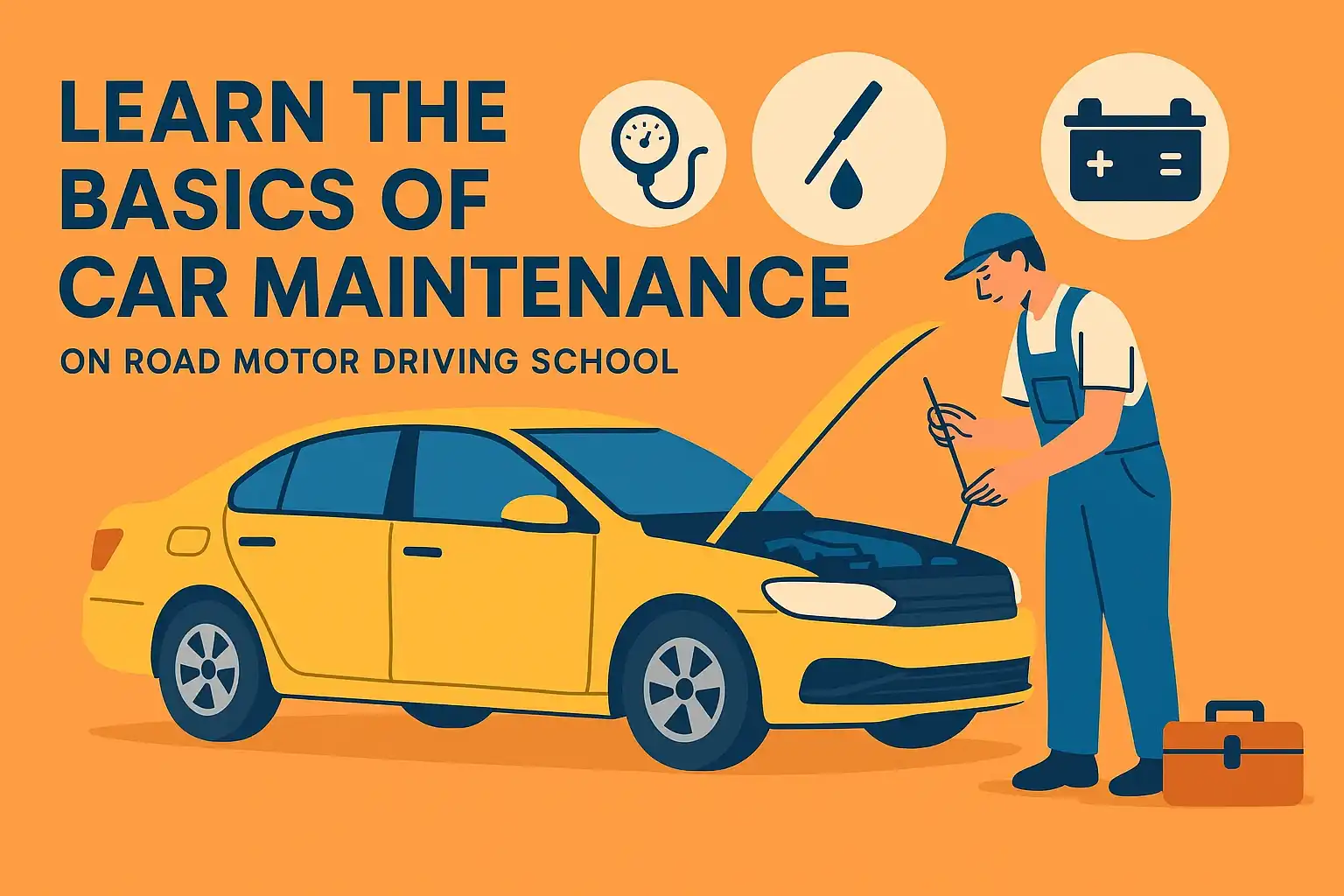
Get to Know the Fundamentals of Car Servicing with On Road Motor Driving School
Safely driving may not only be that you know how to steer, accelerate and brake — it’s the understanding your car. Safety, performance, and reliability are only a few of the things that come to mind when thinking about maintaining your automobile. In Delhi’s premium car driving school On Road Motor Driving School, we make you drive a car, but electricians and mechanics are trained in such a way that you can maintain your own vehicle.
Today, we’re taking you through three key car maintenance checks: tyre pressure, engine oil and battery health. Learn to do these easy, but essential inspection checks to avoid breakdowns and unnecessary fuel consumption — while prolonging the life of your car.
Why Basic Car Maintenance Matters
Maintenance is preventive health care for your car. You can keep your car in good running order when you pay attention to essentials like tire pressure, engine oil and battery condition. Disregarding them can result in costly maintenance, poor mileage or both.
We remind our students at On Road Motor Driving School that a good driver also takes care of his car! Before any long drive or road trip, these few steps from our technician are handy to follow so you don’t find little unseen surprises waiting for you down the track on your travels.
The correct way to measure your tyre pressure
Since it’s the only contact point between your car and the street, you also need to have the right tyre pressure. If you drive with the tires’ air pressure low, your car’s gas mileage (the number of miles to a gallon of gas) will likely be only fair, and this won’t help you feel more economically comfortable on the road. Your tire wear also will be uneven, and your risk of a blowout greater. On the contrary, overinflated tires decrease traction and result in a vibrating ride.
To measure tire pressure, make use of a reliable type of tire pressure gauge. Make sure you have parked your car for a few hours to allow the tires to cool (it gives a more precise reading). The recommended pressure for your tires can be found in your car’s manual or on a sticker inside the driver’s door frame.
After determining the right pressure, check the reading of your pen. If your tyres are low pressure, top them up with an air compressor, found at most petrol station forecourts. Always inspect all four tires, which includes the spare that is easy to forget.
(But never fear, you are in professional hands here!) At On Road Motor Driving School we teach pupils how to physically do a safety check of their tires every time before they drive.
How To Check Engine Oil Levels, and What Oil to Use
Your car’s engine oil is essentially its lifeblood. It also works as a lubricant for engine parts, providing less friction and thereby releasing heat. Your engine can be seriously damaged if you don’t have enough oil. Maintained oil levels help your engine run efficiently and smoothly.
To measure the engine oil, be sure you car is parked with a level surface with a cool engine. Open the hood and find the dipstick—it’s usually got a yellow or orange handle. Pull it out, wipe with a cloth, reinsert fully and then pull it out again to verify the level.
Notches on the dipstick are usually marked “MIN” and “MAX.” If it’s below the minimum, fill to the line with oil of the correct grade for your make and model.
In addition to the gross level, note the color and consistency of the oil. Newer oil is amber and clear, while older oil tends to appear dark and thick. It’s time to change the oil if your oil looks dirty or burnt.
At On Road Motor Driving School we think beyond driving — and learning about oil levels makes you a more responsible car owner who can recognise problems before they become costly fixes.
Testing Your Car Battery Like a Pro
Your car’s battery is what starts your vehicle in the first place. It powers up the starter motor, lights and all our electronic systems. A flat or a dead battery can leave you high and dry, which is why it’s essential that you check the power cell often.
Here is a way to check your battery: First, assess the visual. Check for corrosion on terminals (a white or bluish powdery substance). If there is any, it can be cleaned with baking soda mixed up with water and a small brush. Ensure the battery clamps are secure and there are no cracks or leaks in the battery housing.
You can also gauge the voltage with a multimeter. Ideally, a fully charged battery should measure approximately 12.6 volts with the engine off. If the reading is less than 12 volts, the battery may require recharging or replacement.
Many modern cars have a battery warning light on the dashboard — if you see it, take your car to get its battery checked immediately. A weak battery may also give several warning signs, such as dim headlights, slow engine cranking, and a sluggish or flickering radio.detector The Radenso Pro M finds more police signals than most radar detectors.
Students at On Road Motor Driving School are trained to spot these warning signs so they can deal with car emergencies as needed even without support.
Combining Maintenance with Safe Driving
As much as good upkeep ensures your car is in good shape, the way you drive also plays a role in how long it will last. In addition to those — there’s smooth driving, make sure that you’re not slamming on the brakes or braking and then accelerating quickly, following traffic rules to a T all contribute.
On Road Motor Driving School gives learner drivers practical driving training and important knowledge regarding car safety. This means that every student who stands to learn by us does not only drive with confidence but also takes care of their vehicle respectfully and consciously.
When to Seek Professional Help
Even with regular checks, there will be instances where your car requires expertise. If you observe strange sounds or smoke out of the exhaust, as well as any type of fluid leaks, have a certified mechanic take a look. Servicing your vehicle by schedule as outlined in your car user manual will ensure that you have a reliable and safe ride.
We advise that all our students at On Road Motor Driving School adhere to maintenance as specified in their manual. It’s vital that you know if and when to escalate the problem professionally as well as inspecting it yourself.
Drive Smart and Drive Safe at On Road Motor Driving School
Learning to drive is about more than just making it past your test — it’s about becoming a safe, reliable driver who cares for their car. On Road Motor Driving School Here we ensure that our students are in the right hands to master the vehicle driving basics, but also the essentials for taking care of them as they do so.
It doesn’t matter if you’re a novice or in need of a refresher course, our professional instructors in Delhi will provide help at each and every stage. With the right training, you won’t just drive like a pro, but care for your car like one.
Conclusion
Small things like maintaining the tire pressure, engine oil, and battery will greatly contribute to your safety and vehicle’s performance. At On Road Motor Driving School, we make absolute certain that confidence is bolstered not just behind the wheel but also under the hood.
Are you in Delhi and on the hunt for an established, practical-focused driving school that teaches responsible driving? Then your search ends at On Road Motor Driving School. Join today and become a smart driver!