



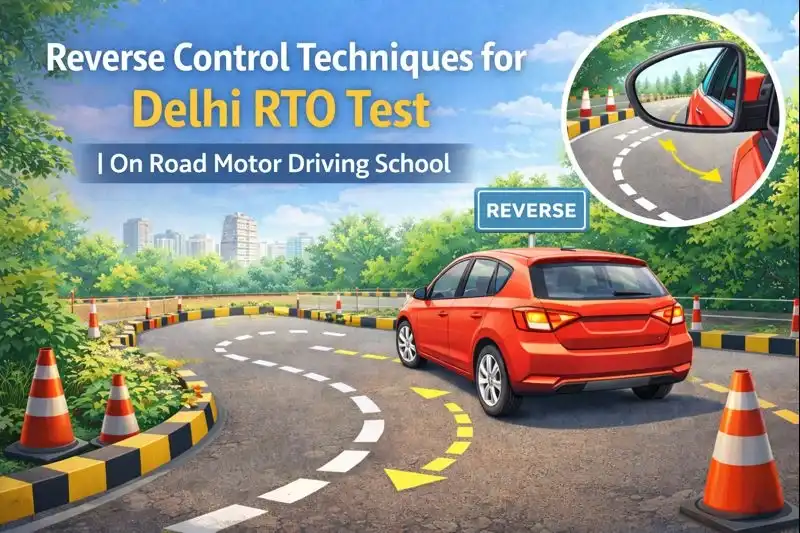
Flip Control methods in Delhi RTO check
Clearing the Delhi RTO driving test is not just about how efficiently you can steer your car ahead or backward. Reverse control is one of the most difficult exercises. Most students are comfortable when they drive straight but as soon as the vehicle has to be reversed, it becomes a nightmare. We believe at On Road Motor Driving School that an ability to cover reverse control can make a big impact on easily passing the driving test first go.
It’s not speed that is a problem with reverse driving. It’s not so much about the flash in that regard, it’s about balance and coordination, observation and staying calm. Knowing the correct method, and practicing it often, can aid in giving you the confidence to execute reversing with ease.
Importance of Reverse Control in the Delhi RTO Test
The test of the Delhi RTO checks a driver’s control over his vehicle in constrained space. Reverse Control Shows capability of driving and combines steering, clutch control, brake and observation. Examiner looks for smooth operation and appropriate judgment/safety precautions.
Inept control: jerky steering, sudden stops, stalling out or crossing bound lines tend to occur. These errors can lead directly to failure. This is the reason why reverse control is an important part of training at On Road Motor Driving School.
Understanding Vehicle Behavior While Reversing
Steering of the vehicle in reverse direction is different from that in forward driving. The back tires get weird and tiny steering inputs yield large course deviations. Sometimes young drivers can oversteer, which makes the car drift out of alignment.
Knowing how this happens is the first step. Reverse control is enhanced when subjects recognize that slow and steady wins the conquest of force as opposed to reacting rapidly. Good handling gives you time to correct things before they get too bad.
Proper Seating and Mirror Adjustment
Good reverse control begins long before the car is in motion. A good seating position puts you in full command of the pedals and the steering. The seat driver should be able to see mirrors very well.
Mirrors are important when reversing. The two side mirrors aid in estimating distance near boundaries, and the rear view serves as an alignment point. On the Delhi RTO test, correct mirror work demonstrates the presence of mind and self control that evaluators like to see.
Coordinating Clutch, Brake, and Accelerator
Reverse Control Controllng in reverse is very pedal-heavy. Over acceleration while reversing is the most common mistake. The car should ideally roll with clutch control and the minimum amount of throttle.
There is also slow movement by half-clutch and better steering accuracy. Just a little brake lightens off speed without inducing panic. On-road motor driving school ensures its students to depend on the clutch balance rather than emergency brakes while reversing.
Steering Control While Reversing
If you’re backing up, your steering should be deliberately slow. It loses its straight-ahead if you steer it quick or mean. Drivers should steer in and out gradually from hands off the wheel to center.
Gaze to the rear direction while you are steering, this way you will know what the car does. Are few adjustments are better than great guiding changes. The examiners are happy when you demonstrate calm steering control rather than quickly turning it.
Reverse Driving: Ability to Observe and Awareness
Reverse control is about observation’ ‘Observation – fundamental to reverse control. Indeed, even in a controlled testing environment, examiners anticipate that drivers will demonstrate some level of perception of surroundings. Obsessively checking mirrors and blind spots is the hallmark of a good driver.
Keeping the head looking back just a little as we reverse keeps us more aligned and aids with distance perception. This practice gives you confidence and eliminates the doubt usually displayed by anxious students.
Frequent Mistakes you must avoid while appearing for Delhi RTO Test
And so many students struggle because of mistakes that can be prevented. Dumping the clutch can result in jerks or a stall. Braking too heavily leads to loss of balance and limits control. If you ignore mirrors, they give rise to severe misalignment and boundary crossing.
Getting spooked and overreacting when the car gets a wheel off line is another common one. Panic results in overcorrection. The best solution during the test is to stay calm and make small changes.
Methods Utilised at On Road Motor Driving School
On Road Motor Driving School reverse control training is delivered in a graded organized manner. “Preparing Learners They begin with simple clutch control exercises and develop to reverse alignment. Test-like situations are created for real confidence.
It is reused again and again to train student how cars are going to behave as well as become “muscle-memory” or instinct. They work on fixing posture, timing and pedal coordination until reverse driving feels comfortable.
Mental Preparation for Reverse Test
Confidence is a huge factor in the success of reverse control. Rush leads to errors in judgment and hasty decisions. Learners should go into the test with a relaxed state of mind and believe in themselves that they have done as much training as humanly possible.
Getting a breath in before you begin, taking it slowly and concentrating on technique rather than fear can make the world of difference. Confidence comes with preparation, and routine practicing is what builds the confidence.
Conclusion
The reverse control is one of the most crucial skills which are necessary to pass in your driving test with Delhi RTO. Titanium: Represents the totality of a driver’s control, awareness and poise behind the wheel. With the right approach, regular practice and proper guidance, driving in reverse is something that you can deal withóeven if itís not always comfortable.
ON ROAD MOTOR DRIVING SCHOOL concentrating on developing the strong reverse control skills for students to undertake Delhi RTO test with confidence. So, learning these strategies is not just about passing the test; it’s about making better and safer drivers on the road.