



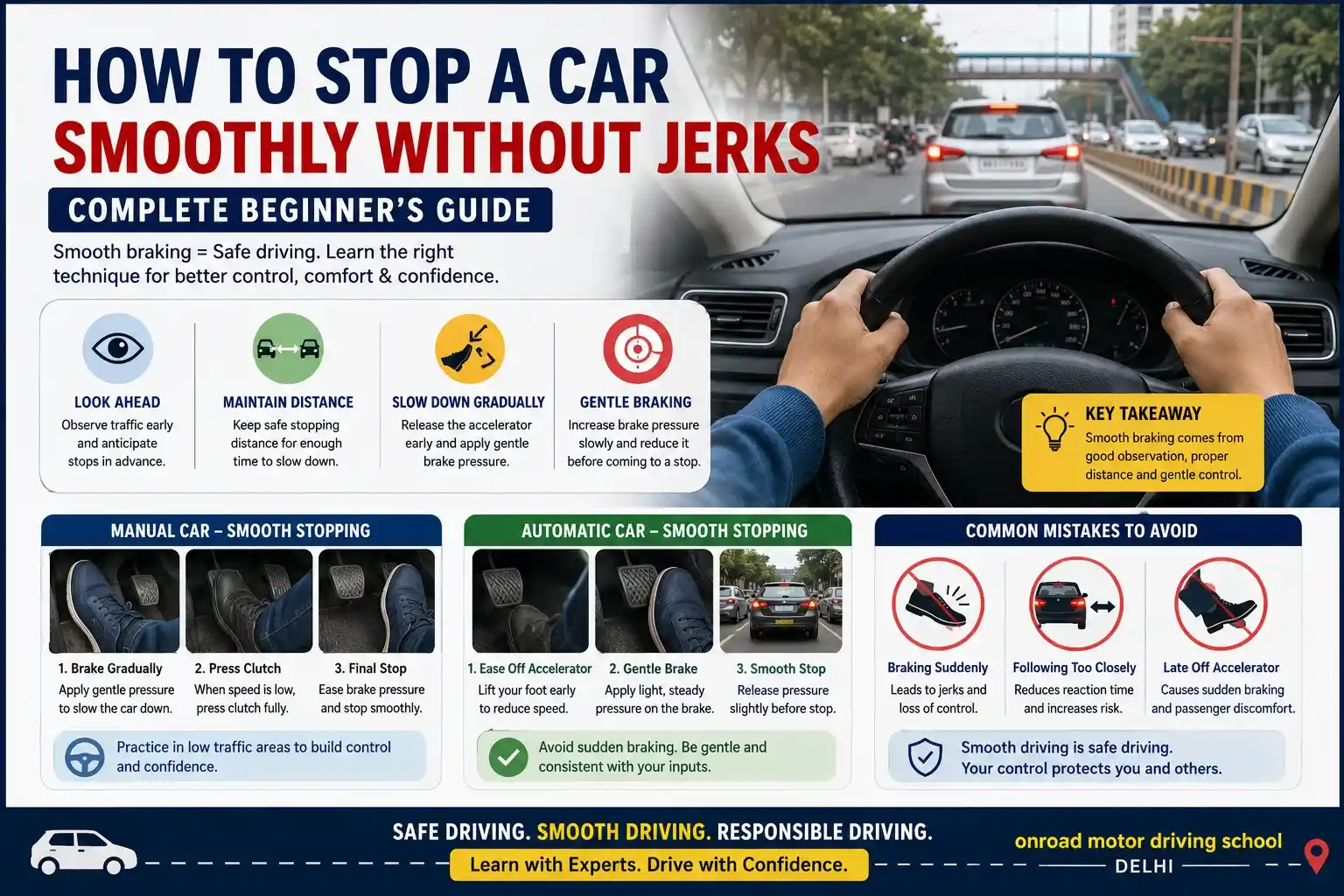
Smoothly stopping the car is one of the first skills that distinguish a confident driver from a nervous novice. New drivers struggle with braking control but they tend to over-focus on steering and acceleration. Braking suddenly or braking hard, and bad timing makes the passenger uncomfortable and vulnerable accident especially in heavy traffic such as Delhi– which is quick to give you several disasters.
Learning to give a car a stop in comfort its not just about…. In low-adhesion conditions, this gives vehicles greater control, less wear on brakes and a way for the driver to respond safely to unforeseen road conditions. Whether you control for student drivers or new entrants into driving schools, almost nothing helps build confidence faster than smooth braking.
Importance of Smooth Braking When Driving
But good car stopping techniques keep your vehicle balanced and stable. Applying brakes suddenly makes the vehicle weight aggressively shift to front, that also reduces comfort and tire grip.
The fact that Indian traffic scenario is a wait, shift and peep to the left exercise makes controlled braking more crucial. Drivers who learn defensive driving methods in India are generally better at handling over-crowded street, walkers and stop and go traffic.
braking quality is also noticed right away by passengers. Braking smoothly makes driving more comfortable, and speaks well of your discipline behind the wheel.
Learn How to Brake Smoothly in the Traffic
The error that beginner drivers most often make is not hitting the brake pedal before it is necessary. Smooth braking starts with observation. Expert drivers look well down the road, anticipating slowed traffic rather than reactively last minute.
During an encounter with red lights or traffic jam, slowly let off the accelerator first. Thus, it is slow down a little before you need to brake. Instead of pressing on the brake pedal directly, pass (decelerate) to hold steady pressure on the brakes lightly.
Just before the car stops, release just a little of the brake pressure as you go from near to no speed on. This prevents the final forward jerk encountered by many beginners.
This comes in particularly handy in the stop-and-go traffic Delhi is known for.
Safe Stopping Distance While Driving
Braking is smoother if a proper distance is maintained from the vehicle that comes ahead of you. Drivers driving too closely to the car in front of them need to brake suddenly more often.
Safe driving distance means that you have enough time to reduce the speed of the car slowly rather than panicking. Especially relevant in the rain, highway, or congested city roads.
As a beginner driver, most driving tips surround controlling the steering wheel; however, managing your braking distance is just as important. Good spacing makes you look more relaxed and in control.
Guidelines on When (and How) to Smoothly Stop a Manual Car
They expect more cohesion between brake pedal and clutch in manual cars. One common mistake taxiing or when starting and reversing is that either the driver presses the clutch too early, causing stalling, or does not press it at all causing jerky movement.
One last thing for a manual car, smooth downshifts through gentle braking. When the speed falls really low, fully press the clutch, while braking steadily until the car stops.
Letting off the brake pressure a bit for the last couple of feet will avoid any sudden jerks. This clutch and brake coordination becomes second nature with practice.
Many times, driving instructors at onroad motor driving school in Delhi teach the learners to pay attention more towards timing instead of force. Smoothness is often born out of patience and anticipation rather than aggressive braking.
Smooth Braking in Automatic Car
Automatic cars do not require any clutch coordination and are therefore usually easier for beginners. On the other hand there are many drivers who still brake too much simply because they only rely on the pedal to slow down and are not planning ahead of traffic flow.
In automatic car driving, pedal sensitivity is crucial for smooth braking. You are better off with light and progressive pressure than sudden inputs. New drivers should be leery of any car that creeps at low speeds, including automatic vehicles, so they will practice light brake modulation.
Many manual-transmission drivers take a while to get used to the lighter pedal feel of most automatics.
Why Your Braking Is Going To Be Jerky Approach
The first problem is keeping your eyes fixated on the short distance infront of you instead of scanning traffic further down the road. Late responding drivers invariably brake suddenly
A second error is keeping the accelerator all the way down until the last moment. By letting go of the throttle sooner, the engine can also provide natural deceleration.
Nervous drivers will also mash the brake pedal in non-critical conditions. Gradual pressure creates controlled braking, not panic reaction.
Braking Problems Caused by Ignoring Road Conditions Over wet pack roads, uneven surfaces, and loose gravel far earlier and with more delicacy.
How to Brake Smoothly Form Practical Driving School Tips
Nothing helps you develop better braking control faster than consistent practice. Beginners practicing brake modulation should seek empty roads or a quiet residential area.
Smooth braking tips taught at driving schools tend to prioritize road awareness over pedal technique. Learn to predict traffic movement, and drivers stop more smoothly, without thinking about it.
Even more beneficial, practicing in at varying speeds lets novices observe how they affect braking distance. There’s more to it than just departing from a stop, slow-speed braking in parking spaces is entirely distinct from highway and busy intersection scenarios.
Conclusion
Knowing how to smoothly stop a car is also one of the best beginner driving skills. For starters, proper braking technique can enhance comfort, safety and vehicle control—even your confidence behind the wheel. If the driver anticipates traffic, stays an adequate distance from the car ahead, and simply presses gently on the brake pedal at first, jerky stops typically occur anyway.
Due to traffic density and some unpredictable road situations, the act of smooth car stopping is even more indispensable for beginner drivers in Delhi. Instructive experience and expert steering from experienced mentors—places like onroad motor driving school, for example—can assist understudies with creating sound stopping propensities right off the bat so that sooner or later they can be more secure drivers all around.