



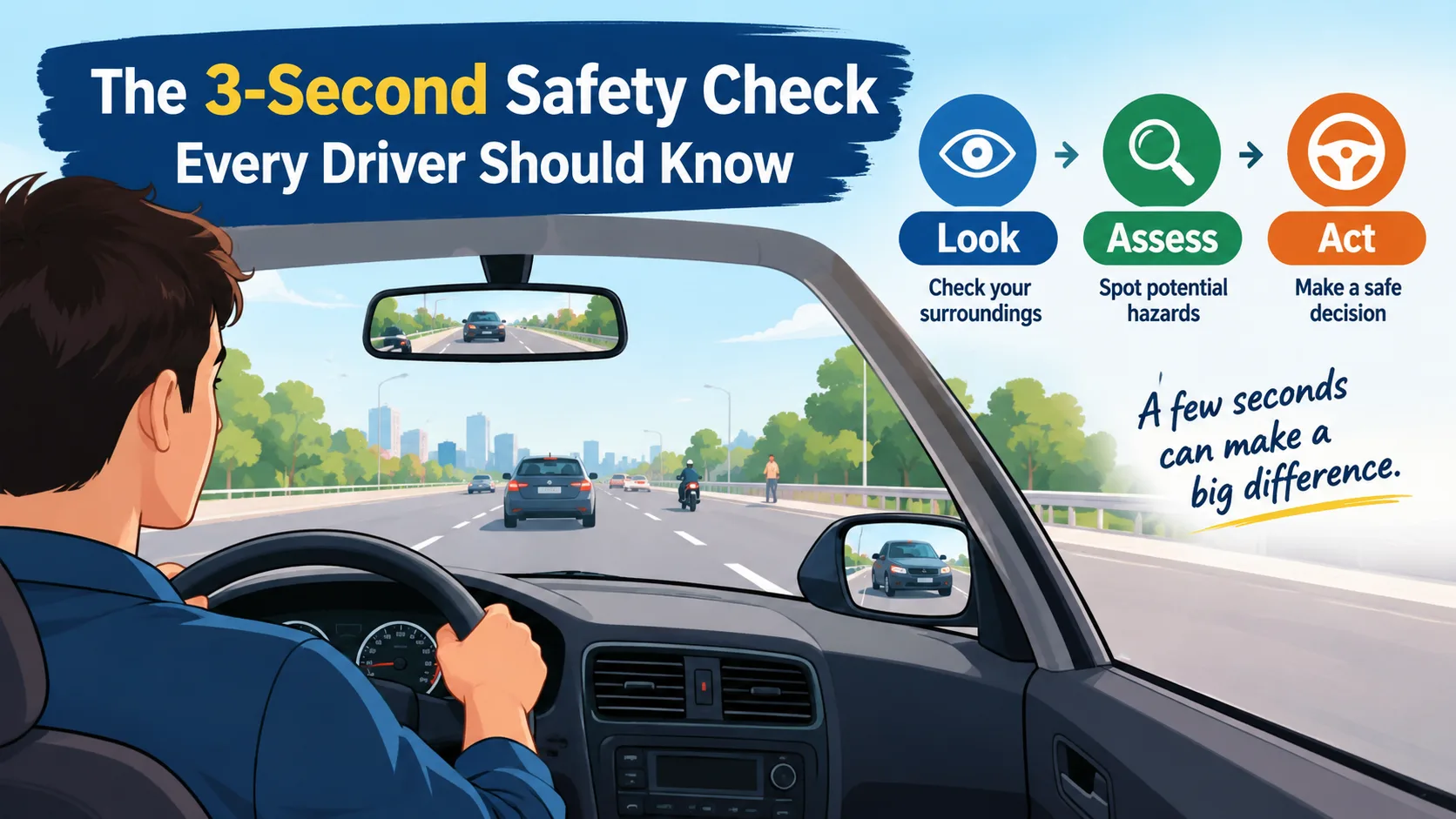
It is not enough to know how control a car in order for it be safe driving. It also has to do with awareness, reading the situation you are in, identifying risks and acting safely at that moment. Both novice drivers that are just learning to drive, preparing for their driving test or experienced as well can benefit greatly from developing some common sense safety habits.
The 3-Second Safety Check is one of the simplest habits that every driver can put into effect. It is a technique that brings you back to just take one second out and look around where the next important car driving move will be.
Onroad Motor Driving School understands that learning to drive is about building essential learnt driving skills and becoming a safe driver. Skill like good observant, judgment about road and should not forget to avoid of defensive driving.
3 Second Safety Check — What is it?
3 seconds Safety Check is a straight forward approach of three steps: Look, Assess and Act.
Make a quick realisation of what is happening around your car before changing lanes, turning, moving away from the place and overtaking vehicles or parking to reverse. Scan the road ahead, look around for traffic or potential hazards and only perform a maneuver when you can be sure that it can actually be performed safely.
This habit is really important for a rookie driver. New drivers are in the process of learning how to observe and react what is happening around them, so taking a moment at an intersection helps ensure that they make more informed choices.
With consistent driving practice, it can become second nature as part of your routine check before hitting the road.
But why the 3-Second Safety Check?
Most common driving mistakes occur when drivers are distracted, impatient, or only pay attention to the thing directly in front of them. A driver may glance in a mirror and see that the road is clear—in fact, another vehicle or motorcycle might be approaching from his blind spot.
A brief watch of the traffic scenario affords you greater time to analyze whether or not it is right before proceeding.
This is a crucial aspect of defensive driving. Defensive driving is being aware of your surroundings and knowing what can happen if a bad situation develops before you get into it, not just staying out of trouble with the ability to react when something occurs.
For learners, it also provides a basis to establish good observation habits early on in their driving journey — laying the groundwork for safe and confident drivers.
The 3 second rule — before every lane switch
Watch carefully before changing lanes — if you change too soon, other vehicles may be approaching rapidly to your rear or hiding in your blind spot.
Check your mirrors and know where the other cars are located before changing lanes. Indicator your manoeuvre when and where required, then check the respective blind spot before proceeding.
Do not ever assume that the driver has seen your indicator. Yes, an indicator states that you intend to change lanes but not make a lane-change safe.
Wait, if the space is not enough. Do not rush just because you have another vehicle behind you.
An essential skill of a competent driver is practicing patience, particularly in terms of waiting for an opportunity to pass safely.
The 3-Second Check Before Turning
Turning is not simply a steering wheel rotation. When turning, carefully look at the road ahead and watch for vehicles approaching from the other way as well as pedestrians, cyclists, motorcycles traffic signs & signals.
Be especially careful in busy intersections and residential streets, nearby schools and around markets as well as at pedestrian crossings.
As a novice operator, strive to visualize beyond the continuation of your lane. The information we gain from observing what other road users are up to may allow us to anticipate hazards before they become an issue.
One of the most essential safe driving skills to develop is keen observation.
The 3-Second Check Before Overtaking
Never rush an overtake. Avoid overtaking vehicles without checking before it like following the traffic ahead, vehicles coming from opposite side of road visibility and space between you.
ASK YOURSELF, do I have enough time and ground to make the manoeuvre. It is advisable to wait for a safer chance if the visibility is poor, traffic conditions are heavy or road-clearance possibilities.
In addition to learning how to pass, one of the most important lessons beginner drivers will need is that it isn’t always appropriate for you try and make a passing move.
It takes proper judgement, not just the willingness to take unnecessary risks and drive like a lunatic.
The 3-Second Check Around Pedestrians
Pedestrians, or cyclist as well however can be quite a unpredictable twists on the road. Drivers must take extra precaution near schools, residential areas, markets and parking places as well such busy pedestrian crossings.
Do not ever expect a pedestrian to stay in the same place. And kids may run towards the street, not even realizing how dangerous it is.
This is the reason it very important for a driver to take Defensive Driving, and awareness of himself as well as road safety. A lincensed driver attempts to predict what other roadway participants will next do and continues alert to safely react.
The 3-Second Check When Reversing
It also takes extra care because the driver has limited visibility during a reversal. Look around your vehicle before reversing, and check from the mirrors.
Watch for people, children, standing vehicles parked on the roadways and walls poles: motorcycles. If you are not sure what is behind your vehicle, either reverse slowly and stop or walk outside round the back of your car.
That’s what figures because while modern cars do have parking cameras and sensors, these should complement your observation rather than replace it. One of the fundamental portions in training to drive safely is developing good parking skills.
How to Hone your Observation skills whilst Driving
Regular practice and professional guidance help you to develop better observation skills. In driving lessons, learners will have the chance to practice checking mirrors and looking further ahead, recognizing hazards including other road users as well as understanding their movement.
Rather than only watching the car dead ahead of you, practice monitoring from farther afield. Acknowledge changing traffic signals, brake lights, pedestrians (crossing) bicycles and motorcycles waiting to manoeuvre vehicles entering from side roads sudden changes in movement of other car/ drivers.
These habits–over time both increase your road awareness and hazard perc