



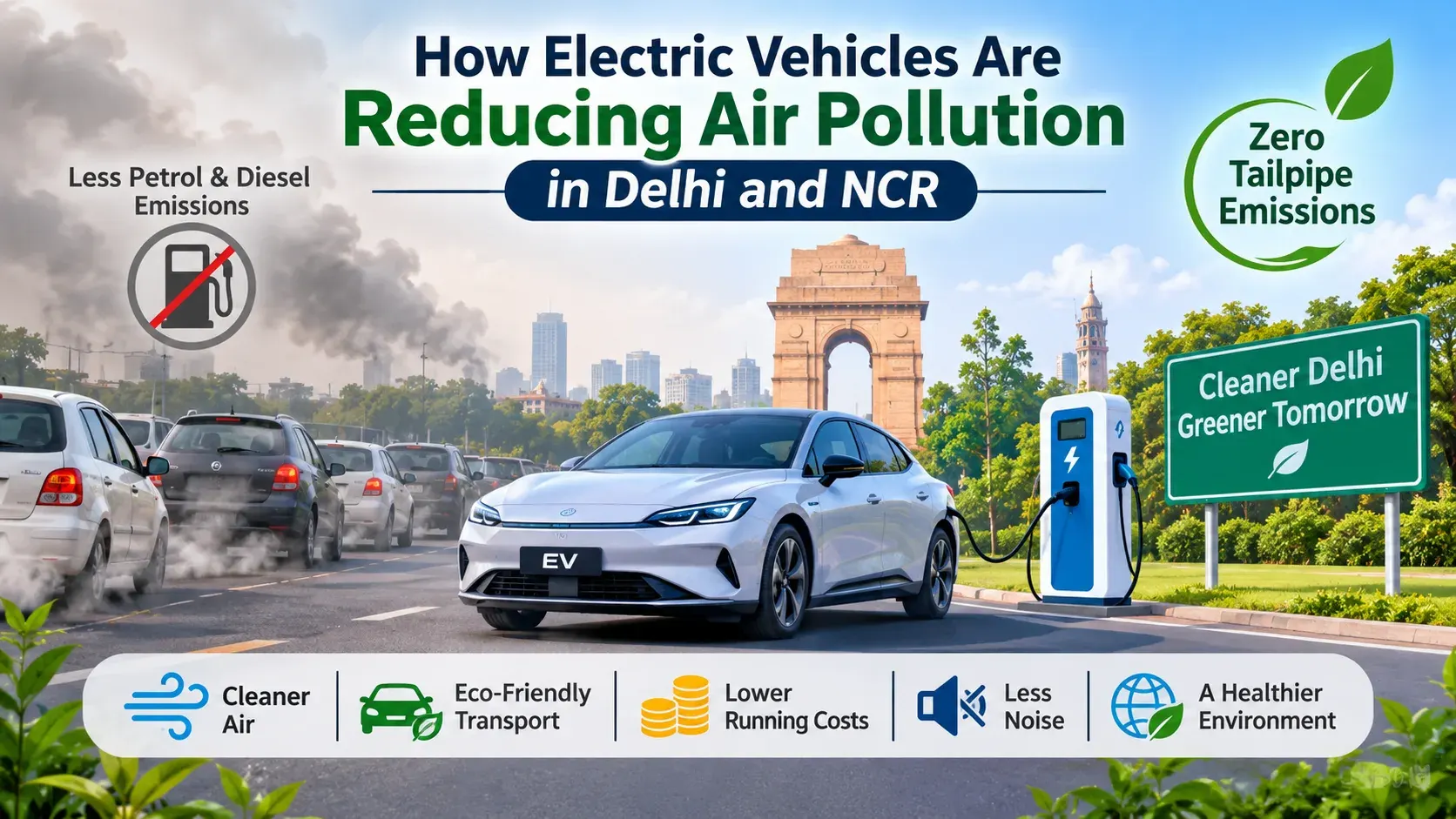
Delhi and the National Capital Region (NCR) are suffering from serious air pollution.Due to an increase in traffic, a rapidly growing population, and the fact that there are thousands of vehicles driving on the road each day, the emission from those vehicles contributes significantly to the poor air quality. Because of people being more educated about environmental problems, electric vehicles in Delhi have started becoming popular as a less polluting alternative to traditional gasoline/diesel-powered cars.
Electric vehicle (EV) technology has the potential to transform both the automotive sector as well as encourage individual consumers to transition toward environmentally-conscious forms of transportation and more sustainable ways of operating motor vehicles. How does EV technology contribute to reducing the amount of air pollution experienced within the city limits of Delhi and the National Capital Region (NCR)?
Understanding the Role of Electric Vehicles in Reducing Air Pollution
The fuel burning in traditional gasoline and diesel engine cars produces toxic chemicals as part of its combustion process. Some of the major toxic chemicals produced are nitrogen oxide, carbon monoxide, and particulate matter. All three of these chemical compounds can produce harmful effects on humans by causing breathing problems, asthma attacks, heart disease and other health issues. In addition, they are major contributors to poor air quality and the formation of smog.
Electric vehicles, in contrast to traditional ones, emit no pollutants from their tailpipes when operated. They do not release emissions from the vehicle directly into the atmosphere as they use electric motors and rechargeable battery packs instead of internal combustion engines that burn gasoline/diesel.
This makes electric vehicles (EVs) a viable alternative to help cut air pollution in most polluted pockets of India including South Delhi, Noida, Gurugram and Ghaziabad.
How Electric Cars Are Making Delhi Roads Cleaner
The most significant benefit of electric vehicles is the reduction in environmental pollution that occurs as a result of daily commutes. There are many hours throughout the day in Delhi when there is extreme congestion due to the amount of vehicles on the road (i.e. office rush hour, school drop-off/pick-up, and weekend shopping). At these times thousands of cars sit idle in traffic, burning gas and emitting harmful gases into the atmosphere.
Electric vehicles can reduce the negative effects of this issue because they produce zero emissions from the vehicle’s exhaust, regardless of speed (slow) or if it is stationary (at a red light). Also, the electric vehicle’s regenerative braking allows for recovery of energy when the vehicle is decelerating; therefore, the vehicle has higher levels of efficiency.
As the number of individuals switching to electric vehicles (cars, scooters, etc.), as well as public transit options (buses) in Delhi increases, the city has an opportunity to transition toward cleaner and more sustainable urban transportation systems.
Benefits of Electric Vehicles for Delhi NCR Residents
Electric vehicles provide numerous benefits beyond just lowering emissions. In addition to being environmentally friendly, EVs typically cost less to run as well. Electricity is often much cheaper than petrol/diesel per km. Also, since there are fewer moving parts within an EV, they need far fewer routine repairs compared with traditional petrol/diesel-powered vehicles.
Electric vehicles have another advantage, which is a much quieter ride. Since electric vehicles produce less engine noise than their internal combustion engine counterparts, this will help lower the amount of noise that people experience from traffic in both highly populated residential neighborhoods and in business districts.
For individuals who travel each day from Delhi to Noida, Faridabad, and Gurugram, using an electric vehicle may provide a feasible alternative to relying upon petroleum based fuel sources.
Why Eco-Friendly Driving Habits Still Matter
While there is no question that electric vehicles are making our streets cleaner, there are many other options than just purchasing an EV to help preserve our planet. There are also many different types of responsible driving habits that will help you reduce the amount of fuel you consume and the emissions your car creates.
Maintain your vehicle, use gentle acceleration, brake smoothly and select energy-saving transport options whenever possible.
At On Road Motor Driving School, a major part of developing good driving habits is learning how to drive safely and responsibly. New drivers who have learned about eco-friendly driving methods will be more knowledgeable about fuel consumption, road safety and environmental care.
The Growing Future of Electric Mobility in Delhi
The transition to cleaner forms of mobility in Delhi-NCR has been slowly taking place as there is an increase in awareness regarding electric vehicles, an expansion of the EV charging network, and an interest in sustainable modes of transportation.
Electric vehicles will not eliminate all of the ways that we are polluting our air. There will still be pollution from how we produce the electricity to charge these cars; there will still be pollution from what happens when the tires of the car wear down; and there will still be pollution from the dust generated by driving on the roads. However, as more people begin to use electric vehicles, they will greatly lower the amount of transportation-related tailpipe emissions that occur in their communities.
The switch to electric vehicles along with environmentally friendly driving habits and proper car maintenance will lead to less polluted roads and a better world for our children’s future.