



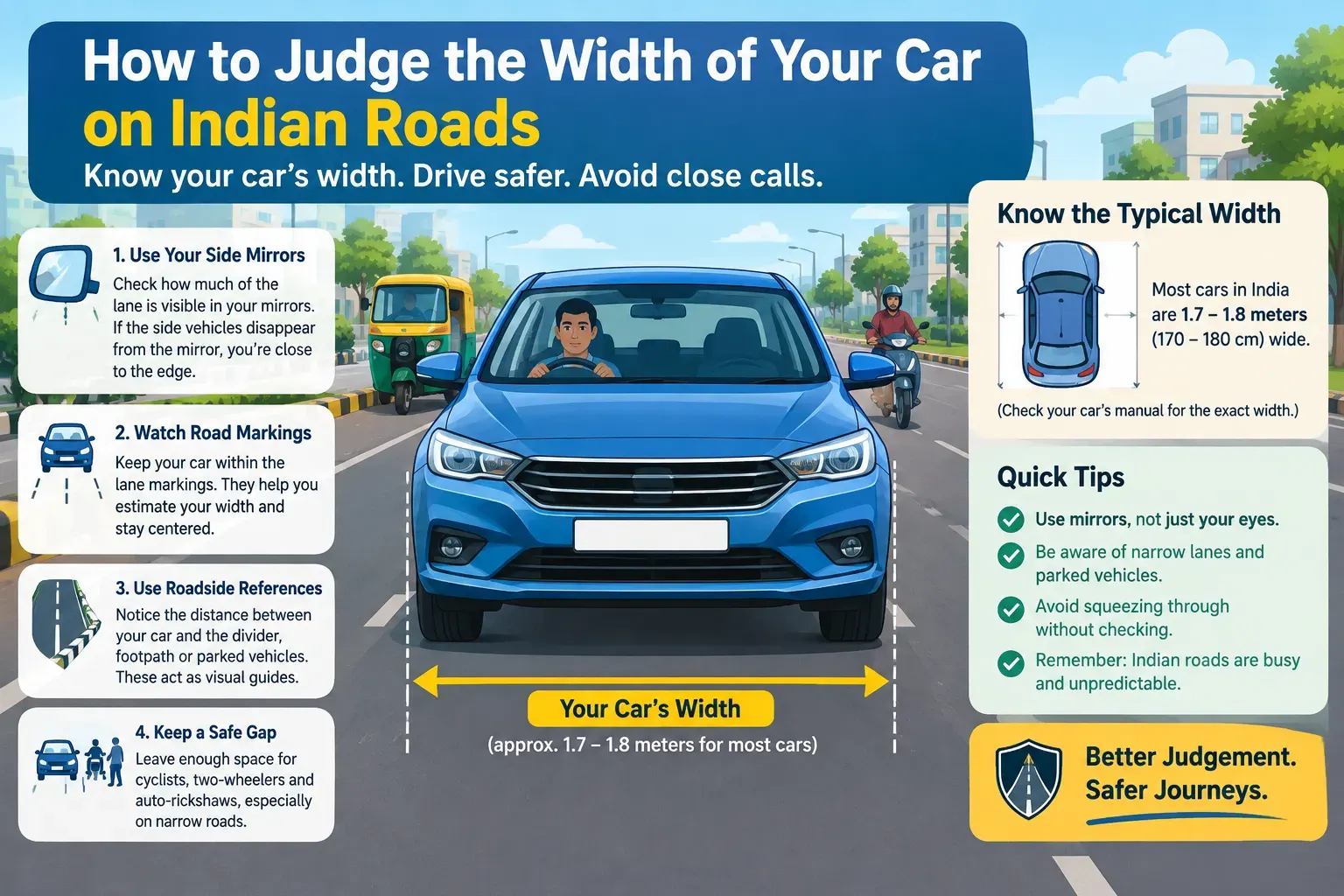
Learning to drive takes time and many beginning drivers find it difficult to know how much room they will need for their car on the road. It looks like driving in a straight line should be simple, however when you are trying to pass another car on a very narrow street or navigate your way through a small space, it can cause stress; particularly if you are in a crowded city such as Delhi in India.
Many new drivers have an anxiety about hitting walls, colliding with other parked vehicles, or getting too close to motorcycles that pass them. These anxieties are completely normal while you’re still in the process of learning. After you’ve practiced regularly, and you’ve gained a better understanding of how wide your vehicle is, you’ll be able to build up your confidence on the road.
Understand Your Car’s Position on the Road
When you begin to drive, it may be hard for you to know where your car is located. Usually the driver’s seat is off center so it may be challenging for you to judge the distance from the left or right side of the car.
Look at what is ahead of you, and think about where your vehicle is relative to the lanes, not just the front of the hood. Take note of all road markings and the distance from each side. When taking driver education classes, it may be helpful to use less traveled roads to practice understanding the location of your vehicle relative to the surrounding environment without being under the stress of heavy traffic.
Use Your Side Mirrors to Judge Clearance
Side mirrors can significantly improve your ability to assess how far away other objects are from your vehicle. They enable you to see things such as parked cars, motorcycles, road barriers, and other vehicles in neighbouring lanes.
Before you begin your journey, check that all your car’s mirrors are adjusted correctly. If you are travelling in an area where there is little room, look at the mirrors in front of you while continuing to look at the road ahead. But remember that your vehicle’s mirrors will have “blind spots”. That is to say that they cannot show every portion of space near your vehicle. Therefore, you should always be aware of what is happening around you.
Practise Driving on Narrow Indian Roads
Learning to drive on India’s congested city streets (such as those found in Delhi) with all of the obstacles that may appear in front of you (parked cars, people walking across the road, businesses along the side of the road, bike riders, etc.) makes it difficult to find a space to maneuver around.
Begin with learning how to drive on less-traveled streets using a licensed driving teacher. Learn what to do so that you can create adequate room between your vehicle and other cars parked along the curb, and do not attempt to fit into spaces where you do not know if your vehicle will be able to get in. When there isn’t enough space to allow you to pass safely, either reduce your speed or stop completely so that you can determine what to do next.
Learn How Steering Affects Your Car’s Position
Even the smallest of steering inputs will cause your vehicle to move further than you may realize. Beginning drivers often make rapid turns on their steering wheels as they pass walls, navigate through tight lanes, and move around other parked vehicles.
Steering should be done smoothly and with control. Before you make a turn, look toward where you intend to go and observe what is happening around you. With each day that goes by, you will become more aware of the size of your vehicle, how much room it takes up when turning, and where it is located on the road.
Avoid Common Car Width Judgement Mistakes
New drivers typically make two major mistakes when they are first learning how to drive. The first mistake is that they pay so much attention to the area of the road directly next to their vehicle that they miss seeing other things that may be occurring further down the road. The second mistake is that they believe that a small opening in traffic will allow them to pass safely if the front of their car will be able to get through.
When considering how far away from the edge of the road to position your vehicle, you should always take into account the entire width of your vehicle (and the position of each of your side mirrors) so that there will be sufficient space on each side. Do not allow yourself to feel rushed when other drivers are honking their horn. Instead, use that time to determine whether or not there is enough room for you to safely move forward. You are much better off waiting for a few seconds to see what is happening than you are risking hitting something and damaging your car or causing an accident.
Build Confidence Through Driving Practice
Judging the width of a vehicle takes time. However, judging the width of a vehicle will become easier as you gain experience through regular practice, patience, and professional instruction. As you continue to drive in India, you should also develop better spatial awareness, side clearance assessment skills, control over your vehicle, and increased confidence while operating a motor vehicle on the roads of India.
With On Road Motor Driving School, students have the opportunity to develop these critical driving skills under professional supervision and with hands-on training. Learning how wide your vehicle is will help you navigate small streets, heavy traffic, and other day-to-day driving scenarios safely and with greater confidence.