



Introduction
As convenience rules the driving experience, automatic cars are gaining traction in the Indian market anyway. Now, the problem there is that quite a few learners do often confuse AMT with CVT and CVT with years-old conventional automatic systems. Knowing the differences between these options is important in regards to choosing the right car and honing driving skills. AMT vs CVT vs automatic: Simple and handy guide
What is an Automatic Transmission?
An automatic gearbox is a type of transmission that shifts gears for the driver without the need for a clutch pedal. This is different from manual cars, where drivers have to be in control of the clutch when driving; here, drivers just have to control the accelerator and the brake.
Automatic cars are comparatively easier to drive and thus a lot of novice drivers and city drivers prefer them as they do not require concentrating on changing gears especially in stop-and-go traffic situations.
What is AMT (Automated Manual Transmission)?
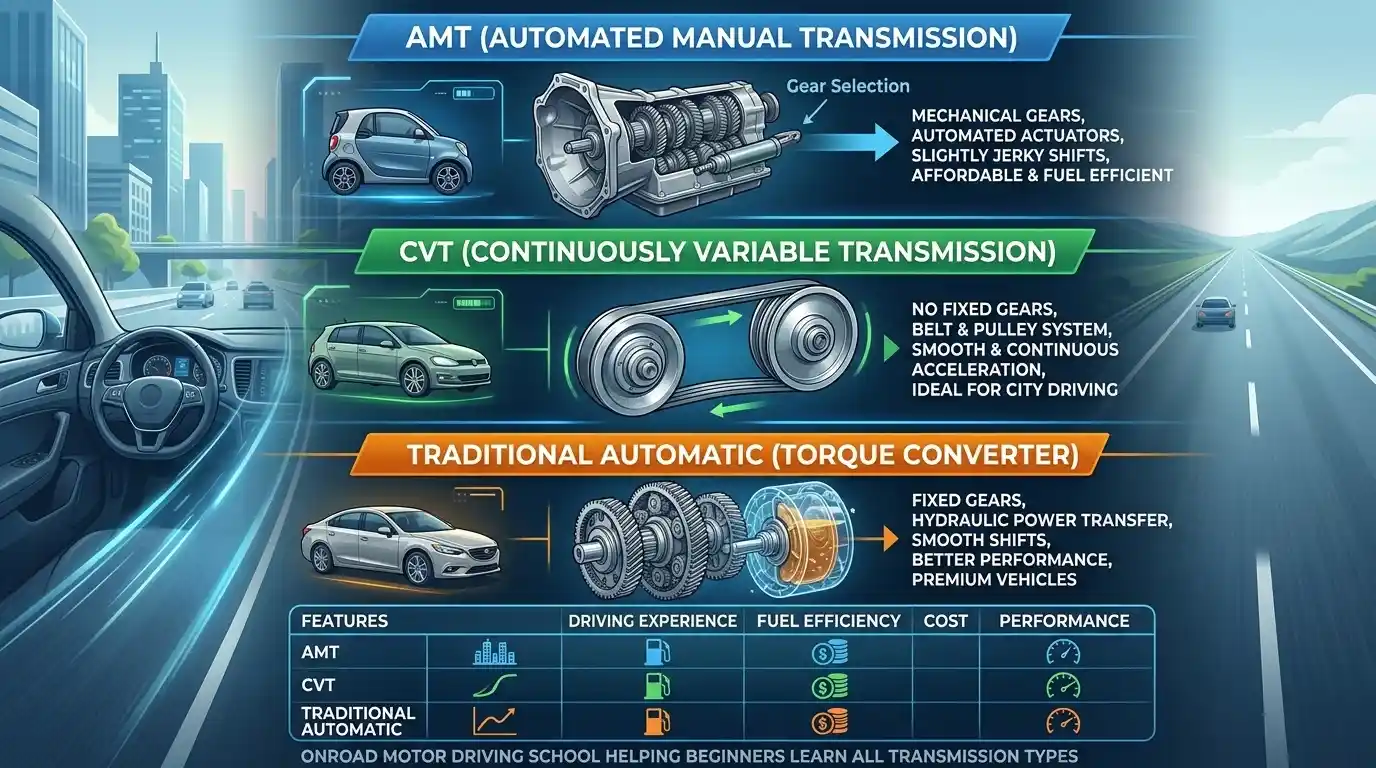
Automated Manual Transmission, or AMT, is as good a manual transmission but automated with the help of sensors and hydraulics. Only way it sorts gear changes is automatically uncontrolled by driver.
Compared to other automatic cars, AMT cars are more affordable and more fuel efficient, too. They can feel a bit jerky when changing gears, though, since they rely on systems for manual transmissions.
CVT or continuously variable transmission is a type of transmission that does not switch between fixed gears.
CVT is a more advanced step that uses a belt and pulley system instead of fixed gears. Hence, the acceleration is seamless and in a steady stream as there are no noticeable gear shifts.
CVT cars are extremely smooth to drive and are comfortable too, particularly in bumper-to-bumper traffic. They’re perfectly suited for the people who value driveability over performance.
What is Traditional Automatic (Torque Converter)
The good old torque converter automatic is a traditional automatic transmission that uses a fluid coupling to transmit power from the engine to the wheels.
It replaces AMT and gives you much better performance in varying conditions along with seamless gear shifts. This is often seen in high-end vehicles and mid-range cars.
AMT vs CVT vs Automatic: Key Differences
Driving Experience
AMT serves automatic convenience on the cheap but lacks the sophistication of some systems, making it very much an automated manual. CVT has the least notches, means that you will be able to experience the smoothest drive without any jerk that takes place from gear shifts. So, old-school automatic strikes a middle ground between purity and performance.
Fuel Efficiency
AMT usually has a higher fuel efficiency than other types of transmission since it is based on manual transmission. CVT also is not bad with efficiency, and traditional automatic can be thirst compared to those two.
Cost and Maintenance
AMT cars are the cheapest and have the least maintenance. These CVT systems are costlier yet much more capable in terms of comfort. Traditional automatic transmissions tend to be the most expensive of the three alternatives.
Performance and Power Delivery
Conventional automatic systems do a better job of things like highway driving and acceleration. Mild acceleration from CVT but not sporty performance For basic human carrier purposes, AMT should be fine but perhaps not strong.
Which is the Best for Beginners?
If you are a beginner automatic cars are easier to learn. If you want a very smooth, hassle-free driving experience, then the CVT is the best bet for you. AMT is a good fit for entry-level users; a course automatic caters to better efficiency and comforts.
Learning the Right Transmission is the Key to Success
Knowing the types of transmission makes it all a bit easier for drivers to decide the car they should go for as well as which driving style would best suit the vehicle of your choice. Somewhat different methods for each, primarily regarding accelerating and braking.
However, even though some of these differences are little, they provide a major difference to overall driving, which is still a significant factor and can be learnt easily by newcomers if they take driving experience with a professional car driving school near Delhi and thus understanding the practical side of them.
How Onroad Motor Driving School Can Help You Out
Onroad Motor Driving School conducts lessons on both manual and automatic vehicles, preparing each learner for different types of transmission systems. Informative but need to mention that such institutes are more concerned over the practical driving related scenario.
With the help of real-time expert guidance, they can practice driving AMT, CVT and other automatic cars that will make them a much better and more competent driver on the road.
Choosing the Right Transmission: Tips
The choice really comes down to the buyer’s budget, level of driving comfort and local driving conditions between AMT, CVT and automatic. So city drivers can go with a CVT or AMT while highway drivers can utilize conventional automatic systems.
Test driving can tell how good each one fits your needs.
Conclusion
Drivers can use AMT vs CVT vs automatic comparison to gauge their car buying decisions. Every transmission type has its own benefits based on your driving behavior, budget, and usage.
AMT is cheap, CVT is smooth and automatic is high on performance. Drivers can quickly become accustomed to whatever type of transmission is used, and the result can be a comfortable experience.