



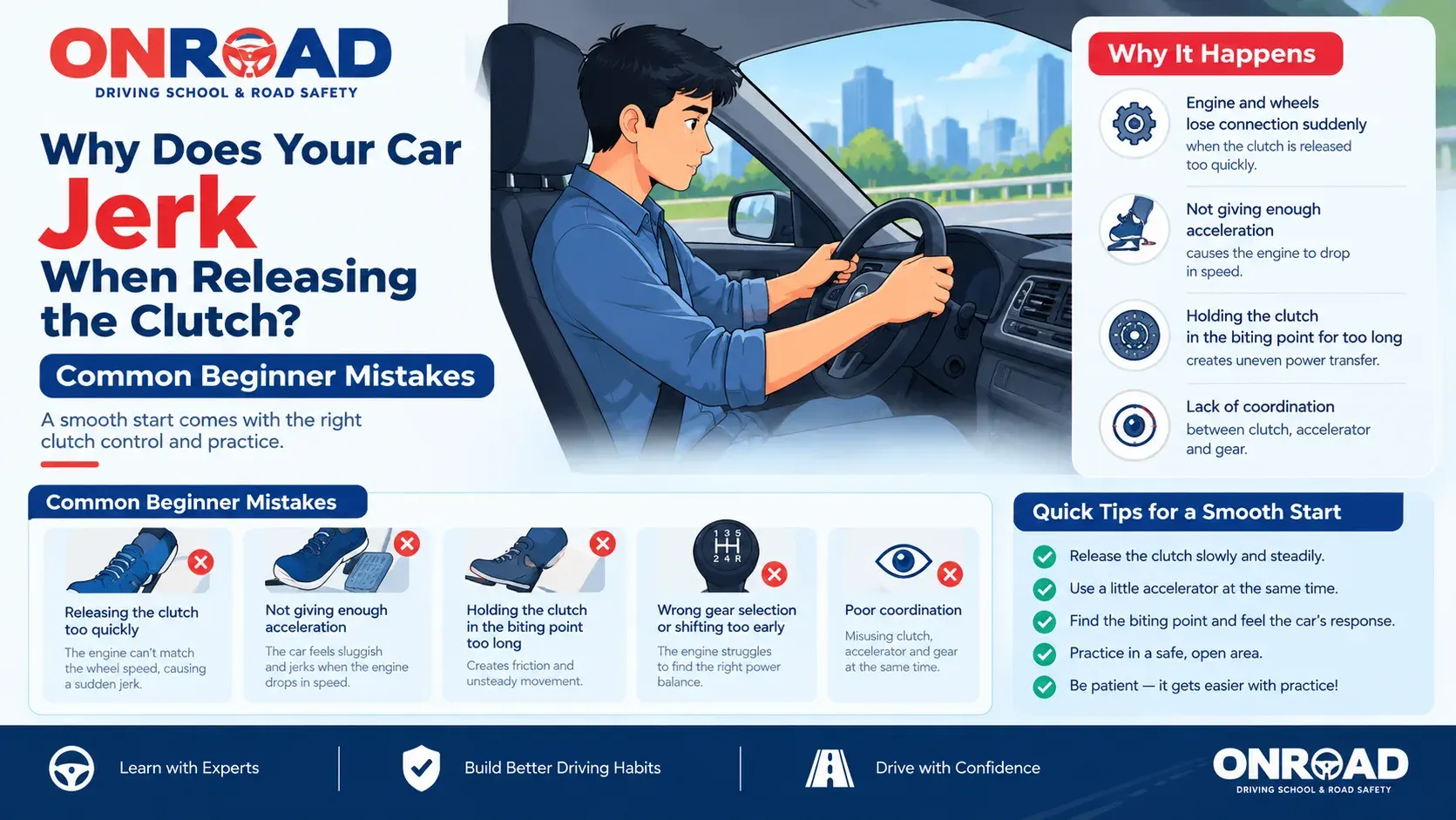
Learning how to drive a stick shift can be tricky at first, as the car can sometimes “jerk” the moment you let off the clutch. This is a common problem for many new drivers, especially when pulling away from a standstill, in heavy traffic or when going uphill. By understanding what causes a car to jolt as you let out the clutch, you should be able to improve your ability to control the clutch, maintain smooth operations on the road, and gain additional confidence as a driver.
Mastering the use of the clutch on India’s roads will be very important for those learning to drive. Because of the amount of times you stop in your car, the amount of traffic you face, and the width of some of the roads you may find yourself driving down, being able to precisely control the relationship between your clutch, accelerator, and brakes will be essential.
Why Does a Car Jerk When Releasing the Clutch?
When a manual transmission car’s clutch is released too quickly, the car can jerk. This happens when the engine does not have enough power to continue moving the car at the same rate of speed as it was before the clutch was released. A manual transmission car has a clutch that links the engine with the gearbox. If you release the clutch too fast, or if you don’t give the engine enough gas (throttle), the engine may lose the ability to keep the car going as fast as possible, which will result in your car jerking or stalling.
The ability to drive smoothly is dependent upon your understanding of the clutch “biting point,” and the ability to coordinate the operation of the clutch pedal with the operation of the accelerator. For beginning drivers, it can take some time and practice to gain that level of coordination.
Releasing the Clutch Too Quickly
The most frequent clutch-control error is releasing the clutch pedal too fast.
When you start to raise the clutch pedal, watch for the time when the engine begins to transfer power to the wheels. Practicing this movement within an open space that is free of obstacles can aid you in developing a smoother start and lessen the amount of extra movement your car experiences.
Not Using the Accelerator Correctly
A manual vehicle may also jerk when you pull away from a stop because of improper use of the accelerator pedal. When you engage the clutch, if the RPM of your engine is too low, the vehicle could experience vibration, jerking, or even stalling.
When you are taking off from a level surface, gently press down on the gas pedal and slowly let out the clutch so that the car moves in response to how you drive. Do not apply too much pressure to the gas pedal, as this will lead to a very fast revving engine, and if you rapidly release the clutch, the car may suddenly lurch forward.
The objective of maintaining a proper engine speed while engaging the clutch smoothly.
Not Understanding the Clutch Biting Point
The point where the clutch begins to connect the engine with the transmission is referred to as the “clutch biting point.” To be able to recognize this point is a necessary part of learning how to drive a manual vehicle.
If learners let go of the clutch before they understand what is meant by “the biting point,” then they might release the clutch pedal too quickly or even push it back down when there was no reason to. Both of these would result in an uneven flow of the vehicle.
With the use of supervised practice, you will develop the ability to notice subtle changes in your car’s engine sound, minor movements of your vehicle, and the sensation of your clutch pedal. These indicators provide you with a greater sense of confidence in controlling your car as you start up, stop, and maneuver at slower speeds.
Why Does the Car Jerk in Traffic or on Hills?
When driving through slow-moving, congested traffic, it may be harder to control your clutch. As you stop and start again, you may find that if you release the clutch too fast, or apply too much gas (acceleration), you will experience a rough ride.
Hill starts need extra care because of gravity which may pull your car backward. Apply the proper brake technique for your car, (e.g. handbrake method) if applicable, and coordinate the clutch and accelerator carefully. Do not use prolonged clutch slipping as a way to stop your car from rolling backward on a slope.
When driving on the congested streets of India, allow adequate room for other vehicles to pass by and do not rush through traffic just because a driver is honking at you from behind.
Can Mechanical Problems Cause Car Jerking?
Although mechanical issues can cause jerking (as can improper use of the clutch), other factors such as a worn out clutch, an engine misfiring, faulty engine mounts, fuel delivery issues and/or problems with the vehicle’s transmission can all result in abnormal vibrations and/or uneven acceleration.
A qualified auto mechanic should assess the vehicle if it continues to experience jerky movement when operating the clutch smoothly, or if you begin to experience burning odors, strange sounds, continuous vibration, or difficulty shifting gears. It would be wise to avoid assuming all clutch related issues are due to how you drive.
How to Improve Your Clutch Control
To enhance your ability to control the clutch, practice consistently in a safe setting under the guidance of an experienced driving instructor. Work toward achieving a smooth release of the clutch, apply the right amount of throttle, brake effectively and understand where the clutch engages (biting point) prior to attempting to operate in more difficult environments.
Do not keep your foot on the clutch pedal while you are driving, as this will lead to unnecessary clutch wear. Only use the clutch when necessary, and refer to your car’s manual for proper use of the clutch.
Learn Smooth Manual Driving With On Road Motor Driving School
Understanding why a vehicle will jolt or shake when you release the clutch is essential for beginning drivers to build confidence. Through proper clutch control, coordination of your foot on the gas pedal (accelerator), and sufficient practice time, novice drivers can decrease the frequency with which they stall their vehicles, enhance their overall control over their vehicles, and create better, more fluid driving techniques.
On Road Motor Driving School provides students with the opportunity to acquire necessary driving knowledge and skills using hands-on training, as well as on-going supervision. Developing good driving practices as early as possible will provide you with a smoother transition into manual vehicle operation, which will also allow you to feel more confident when operating on today’s roads.