



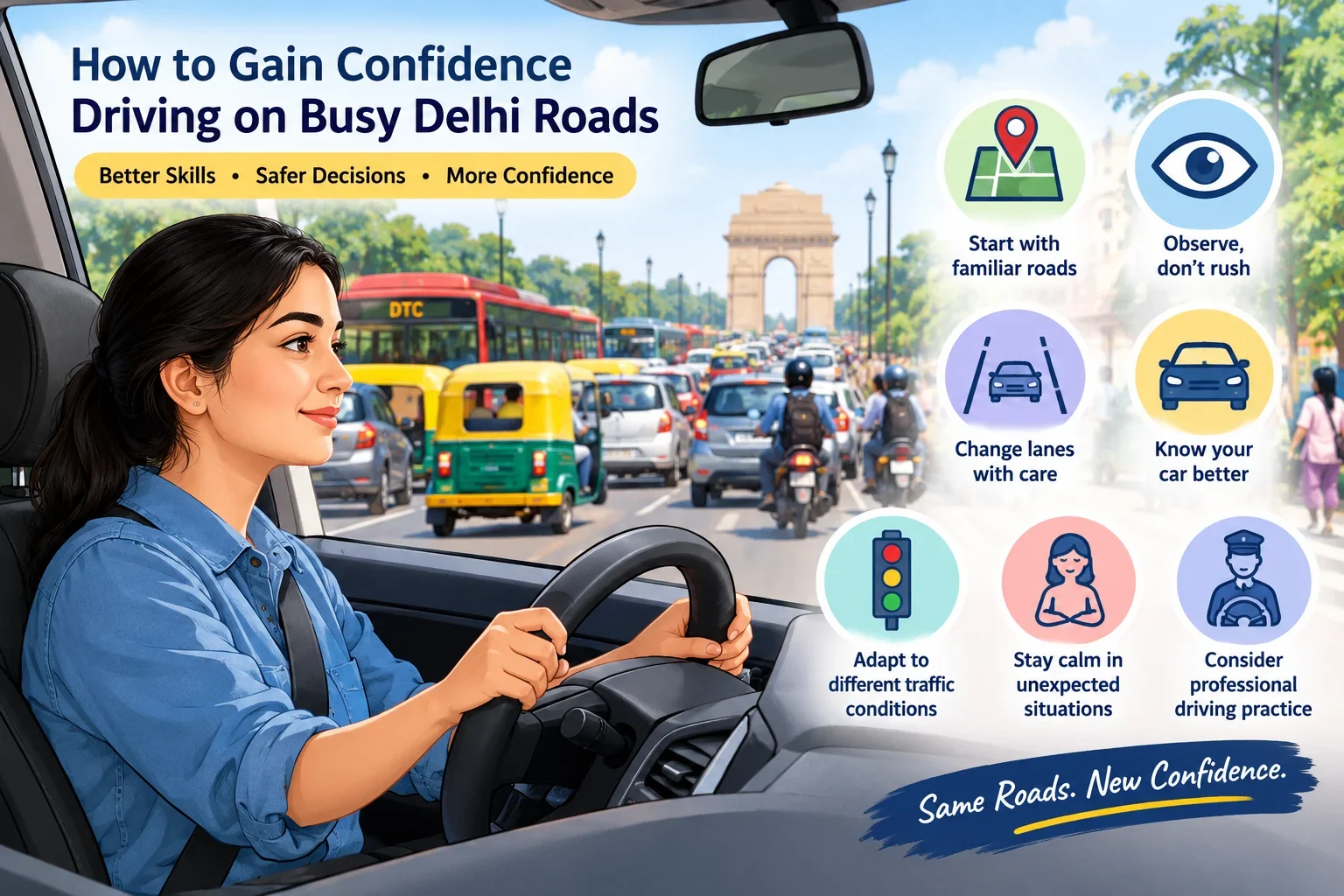
Driving in Delhi with all its traffic, such as other drivers (cars, motorcycles), pedestrians, buses, auto-rickshaws, and frequent lane changes at busy intersections can be overwhelming for those who are just starting out to develop their driving skills. As much as it may seem like a familiar route is challenging to navigate; being nervous about driving does not equate to being a poor driver. Confidence in driving typically grows with the knowledge of how to operate a vehicle safely and effectively, the opportunity to practice often, and learning how to respond appropriately to different scenarios without rushing.
The objective is to be able to make smart choices when operating a vehicle in heavy traffic over time; not to get rid of your fear in one day. Through the use of effective training and support, you will slowly develop the confidence required to drive on the chaotic streets of Delhi.
You can use roads that you know.
Driving on a road that you do not know can make it harder for you to drive safely; as well as being able to control the car in traffic, you have to find out how to get to your destination. As long as you are still learning to drive, then use the roads and routes that you know best.
You will have less of a need to check your directions when you are on roads you know well. When you feel at ease with how the traffic moves around you, when you make turns, when you use signals, and when you change lanes, then you can slowly start to add in roads that are busier or ones that you do not know.
The driving experience can be more predictable with this type of approach; as well as building confidence in yourself naturally.
Speed is less important than observation.
When driving in heavy traffic, many inexperienced drivers may feel compelled to respond quickly. However, being a skilled driver does not require you to make all of your decisions immediately. Instead, it involves watching the actions of others nearby and reacting with composure.
Check your rear-view and side mirrors constantly; keep an eye on the road directly ahead of you; and watch for cars that are about to enter your lane. Try to anticipate how other motorists will react prior to them making a action. An example of this is when a car is getting closer to the line of your lane, it may be getting ready to pull into that lane.
The better you are able to see what is going on, the longer you have to respond to it. Additionally, having more time to react will make you feel like things aren’t happening so quickly.
To practice lane changes without feeling rushed.
When you are driving in Delhi, changing lanes is a situation which can cause many new drivers to feel anxious. It is important to remember that when making a lane change, you do not have to make an emergency decision.
Prior to moving, check all mirrors and blind spots, signal your intention with an indicator, and determine if the area you are attempting to move into will accommodate your car. If the opening doesn’t seem to be large enough to safely enter, it’s okay to wait until you find a better opening.
Improve Your Knowledge Of Your Car
Confidence is also gained by being familiar with how your car operates. Many times, new drivers will be uncomfortable due to lack of knowledge regarding their car’s width, the distance it takes to stop (brake), the amount of room needed for a turn, and where the car is positioned within the lane.
Practice getting used to where the front and side of the car are when you’re sitting behind the wheel. Use this practice to improve your ability to smoothly slow down, accelerate with control, turn, back up, and park safely.
As those movements are practiced over time, it will take less brain power to consider how to operate the controls of the vehicle and more of your focus on the traffic in front of you.
The way you should practice your driving will vary depending on the type of traffic you are in.
When someone is just starting to learn how to drive they may gain a false sense of security by only driving on less traveled streets. Once those streets become more congested however, the new driver will find themselves with less confidence. On the other hand, if the first place a new driver goes to practice is one of the most crowded areas in town; it can overwhelm the new driver.
I would recommend using a gradual approach to practicing driving. I would suggest beginning by driving when there is light to moderate traffic. As you gain more confidence in your ability to handle the car, you may want to begin practicing during heavier traffic conditions. In addition, you may want to try practicing at larger intersections and/or on roads with higher rates of lane changes.
By gradually exposing yourself to various types of traffic in Delhi, you can learn about the many aspects of dealing with such environments without having to endure unnecessary stress during each of your driving sessions.
The ability to remain calm during unexpected changes in traffic is an essential skill for drivers.
Busy roadways seldom function in the manner which one would anticipate; therefore, it is possible for vehicles to make sudden stops, for pedestrians to cross in front of you without prior warning, and for bicyclists to ride alongside you as you change lanes.
When an unplanned event occurs, do not take action immediately. Allow yourself time to react calmly, continue operating your vehicle safely, and find a way to safely respond. Often, taking a minute to think about what has happened will be more effective than acting on emotion.
If you find yourself repeatedly struggling in similar situations, practicing with a qualified instructor will provide insight into how to improve your decision-making abilities.
Consider Professional Driving Practice
Many students experience loss of confidence due to practicing without knowing if what they do is correct. Professional training will help you with feedback regarding your ability to position your car in lanes, watch for traffic around you, apply brakes, turn the wheel, park, and generally control your car.
The use of on road motor driving schools may be of assistance to those individuals who are looking for structured driving instruction as opposed to merely getting experience driving in traffic; the goal should be to acquire the necessary practical driving abilities so that they may eventually drive on the streets of Delhi independently.
Conclusion
It will take some time, consistent practice and exposure to various types of traffic scenarios for you to gain the confidence necessary to drive safely on the busy roads of Delhi. While you don’t necessarily have to completely remove all feelings of nervousness from your mind prior to becoming a safe and confident driver, it is important to develop good observation skills, control over your vehicle, make good judgments about changing lanes, and remain calm during periods where traffic conditions are unpredictable.
With increased experience and proper instruction, the fear of driving on heavy-traffic streets will decrease over time. What was previously an overwhelming situation will eventually be just another part of your daily routine as a driver.