



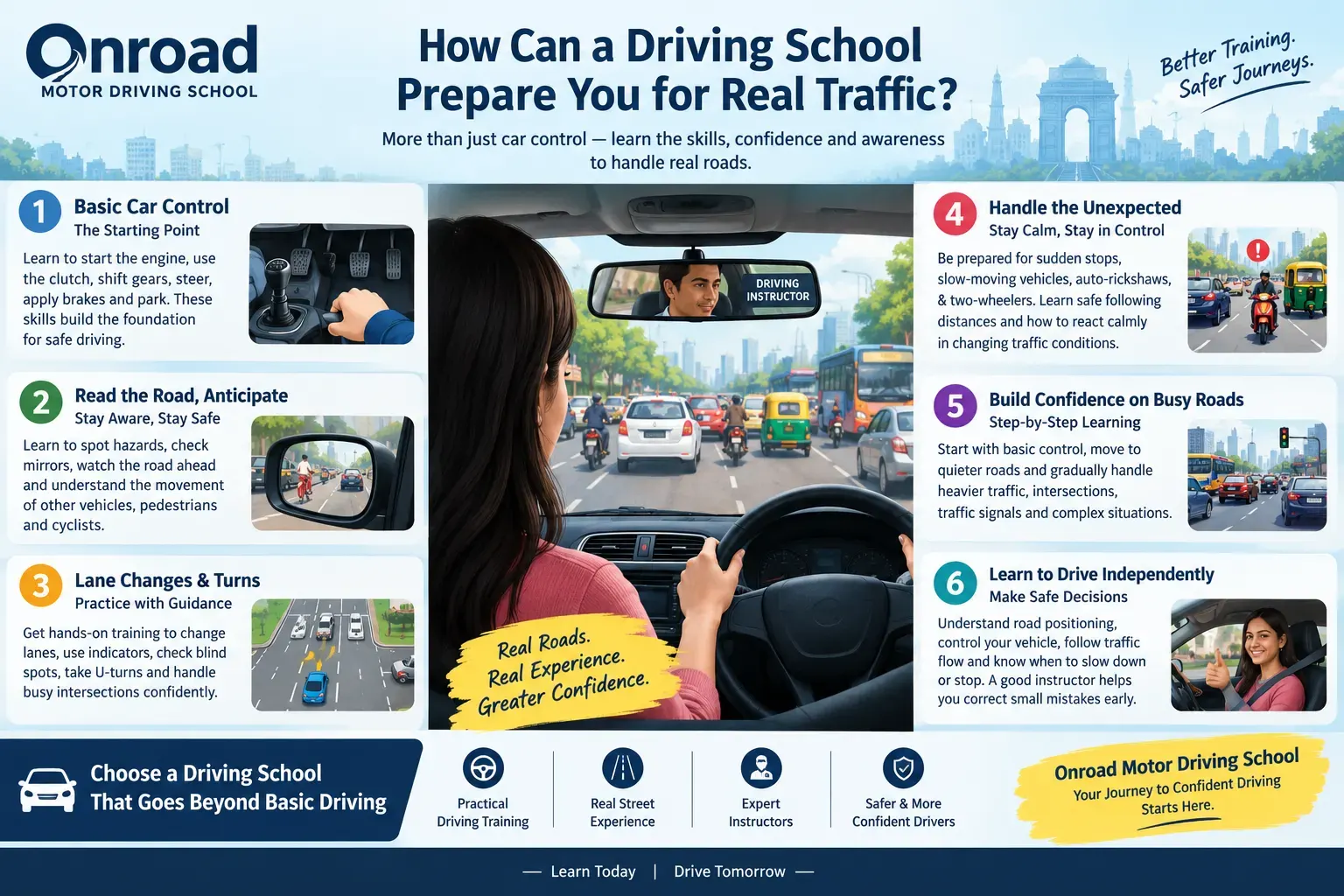
Once a novice learns to operate a motor vehicle, they have just begun the process of developing confidence while behind the wheel. The beginner has likely learned to turn on the engine, operate the clutch, shift through gears, steer the vehicle, apply the brakes, and pull into a parking space. However, operating a motor vehicle on public streets involves far more than this. When entering heavily congested areas of traffic, the driver must be able to assess the flow of traffic, accurately estimate the distance between themselves and other motorists, react to the actions of those around them, and make quick yet safe decisions. Therefore, selecting the most appropriate driving school will help determine how adequately prepared the student feels to navigate the challenges presented by actual traffic conditions.
Beginner drivers at Onroad Motor Driving School have an opportunity to learn the basic principles of controlling a vehicle as well as develop practical skills for being on the road. The objective of effective driver education is to assist beginners in gaining a better understanding of how they may successfully respond to actual driving scenarios with increased self-assurance and knowledge.
Basic Car Control Is Only the Starting Point
In order for a new driver to successfully drive through traffic, they must first learn how to control their vehicle. These fundamental skills include controlling the gas and brake pedal, steering the car with smooth movements, shifting the gear correctly when driving a manual transmission car, and keeping a steady speed.
However, the ability to control a vehicle doesn’t automatically mean that you are prepared to drive on busy streets. In addition, you need to learn what to expect when driving near other vehicles, people walking, motorcycles, buses and at intersections. Professional driving instructors will teach students how to gain experience with these types of situations through a gradual process while taking their driving lessons.
Learning to Read Traffic
As part of practical driving education, it is essential that you learn to understand the events that take place around you. The flow of traffic changes very quickly. A driver in front of you could stop suddenly; a cyclist could enter your lane; a pedestrian could cross without warning.
: Driving lessons should provide beginners with an understanding of what to watch for when there is potential danger. Regularly checking mirrors, keeping track of other cars around you and watching the road ahead will allow a student driver to identify hazards before they are upon him/her.
In Delhi, with its unpredictable traffic patterns, being aware of your surroundings on the road is especially vital during the process of learning to operate a vehicle.
Practising Lane Changes and Turns
For new drivers, changing lanes can cause anxiety. This is particularly true if there are multiple cars in the vicinity. New drivers need to learn how to check their mirrors, indicate, check their blind spots, control their speed, and know when it is appropriate to change lanes.
Driving schools that are effective will offer students the chance to practice the previously mentioned driving techniques with an instructor’s guidance. Additionally, the same opportunity exists for students to learn how to turn at an intersection, take a U-turn and approach a highly congested intersection. When students have the chance to experience these types of scenarios in a controlled environment, it makes it easier for them to handle the situation independently once they begin to drive on their own.
Preparing for Unexpected Situations
In reality, traffic does not always act predictably. For example, a vehicle can abruptly come to a halt, an auto-rickshaw might reduce speed with little notice, or a motorcycle may emerge out of nowhere. Novice drivers are likely to experience anxiety if they encounter the unpredictable in traffic.
Driving instructors can use practical driving lessons to expose students to these scenarios incrementally. Rather than just teaching students the “rules of the road”, driving instructors can teach students what constitutes a safe following distance; when to slow down; and how to stay calm during changing traffic patterns.
The goal of teaching a driver is not to provide knowledge of all potential scenarios, but rather to help establish safe driving practices which allow the driver to respond appropriately in the event of an unforeseen circumstance.
Building Confidence on Busy Roads
Confidence in driving develops through experience; however, a beginning driver should not be forced onto heavy traffic streets until he or she is prepared. Typically, the progression of effective driver training begins with developing control over the automobile, then moves onto relatively quiet streets, and lastly progresses to more difficult driving situations.
As learners develop their driving skills, they may have an opportunity to practice driving through intersections, making lane changes, responding to traffic signals, and keeping a safe distance between themselves and other vehicles. This step-by-step approach allows novice drivers to continue to develop their skills and to remain able to manage the complexity of driving without being overwhelmed.
If you are looking for driving school in Delhi, you should check whether they give on road training apart from just giving certain hours of training, or at what cost.
Learning to Drive Independently
The main goal of taking driving lessons is so that you can make good choices on your own, rather than relying on someone else to make those choices for you. To do this, you will need to understand where to position your car on the road, pay attention to the flow of traffic, keep control over your vehicle, and know when to slow down or stop.
A driving instructor must point out common errors during the lesson, so that the student may rectify these errors prior to establishing them as a regular driving habit.
Choose Training That Goes Beyond Basic Driving
Learning to operate a motor vehicle goes beyond just getting your car from point A to point B. Operating a vehicle successfully also requires you to be aware of what is happening around you on the road, make appropriate decisions based on those observations, exercise patience when necessary, and adapt to the constantly evolving nature of the road environment.
As a result of this, a quality driving school should offer more than just elementary car driving instruction. The use of practical driving experience, actual street driving experience and the support of an experienced driver educator can assist novice drivers in building the necessary self-assurance required to drive on a regular basis.
This can help the Delhi’s beginner drivers to gain the confidence and safety to become a good motorist. It is important for the first time driver to select a driving school that provides teaching of both vehicle control and on-road driving techniques.